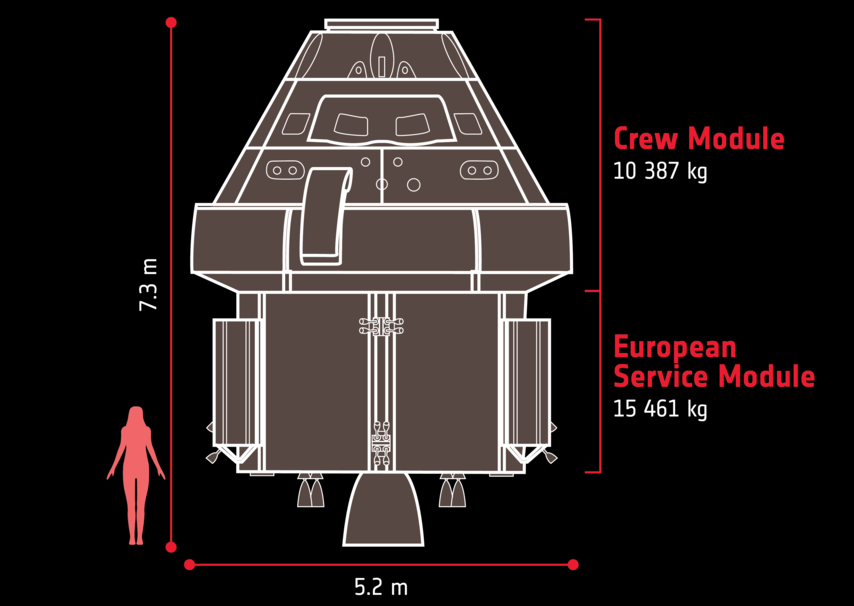
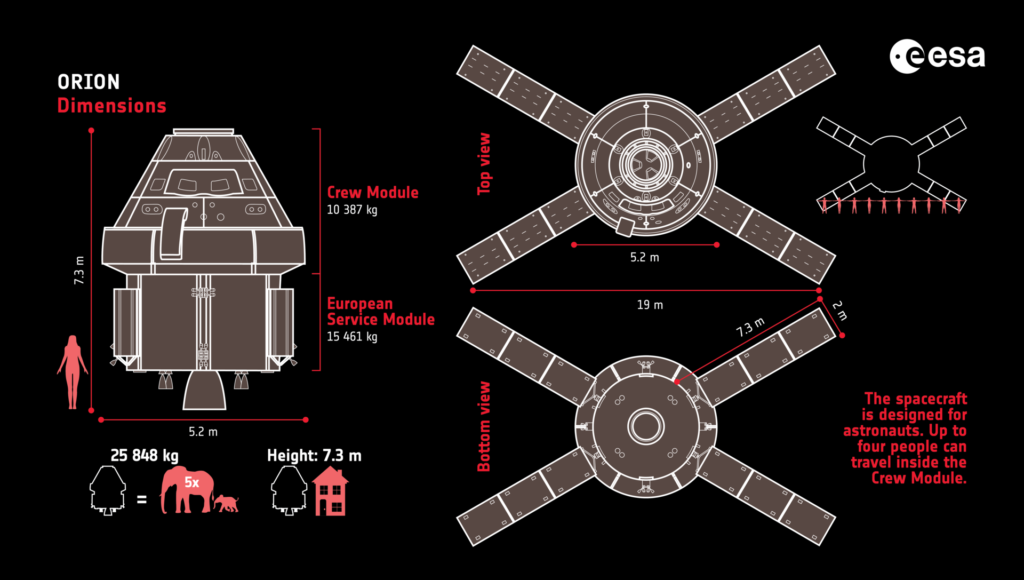
There is a new contender in the human space race. The NASA/ESA-built Orion ESM spacecraft is the most versatile spaceship humans have ever built.
After the US space shuttle was cancelled in 2011, the Russian Roscosmos was the only solution to get humans up into orbit. SpaceX finalized the Dragon Crew Capsule in 2019 and started offering astronaut seats to space in the Crew Capsule on top of its Falcon 9 Rocket in 2020.
Orion ESM: A Versatile Spacecraft
Jeff Bezos’ Blue Origin offers flights just below the orbital range, as does Richard Branson’s Virgin Galactic. Both are in the planning and development phase to offer flights above the Karman line and into orbit, with Blue Origin likely being the closest to succeeding.
During the years Roscosmos was the only option, the Russians charged around 50 to 60 million USD per seat. No wonder, then, that SpaceX set its price-per-passenger at exactly 55 million USD. To date, there are no other private options to get to orbit anywhere in the world.
Millions of Dollars per Launch
There is obviously a lot of money to be made in space. SpaceX is not the only company that has realized this fact. Over the coming years, there will be a flurry of announcements from new and hopeful contenders in the orbital launch race.
The NASA-supported Orion is not built to hit rock-bottom prices for astronauts; rather, it’s a new science and exploration platform. The water and air filtration systems onboard can keep astronauts alive for months.
The characteristics of the Orion spacecraft make it well-suited for the private space industry, as the module is reusable. After a completed mission and release of the crew compartment, the ESM (European Service Module) ship can continue to function in space, remotely controlled.
There is really no point in comparing the cost per seat in the Orion Spacecraft, as it’s still in the billions-per-launch range. The objectives are different. The goal of Orion is not to compete with Roscosmos on price-per-seat to orbit. Orion is a more complex and versatile craft that can perform a multitude of scientific tasks and travel to many different destinations in the solar system. You could send humans to the asteroid belt in an Orion, and that will likely happen in the coming years.
Even More Reusable Providers Are Coming
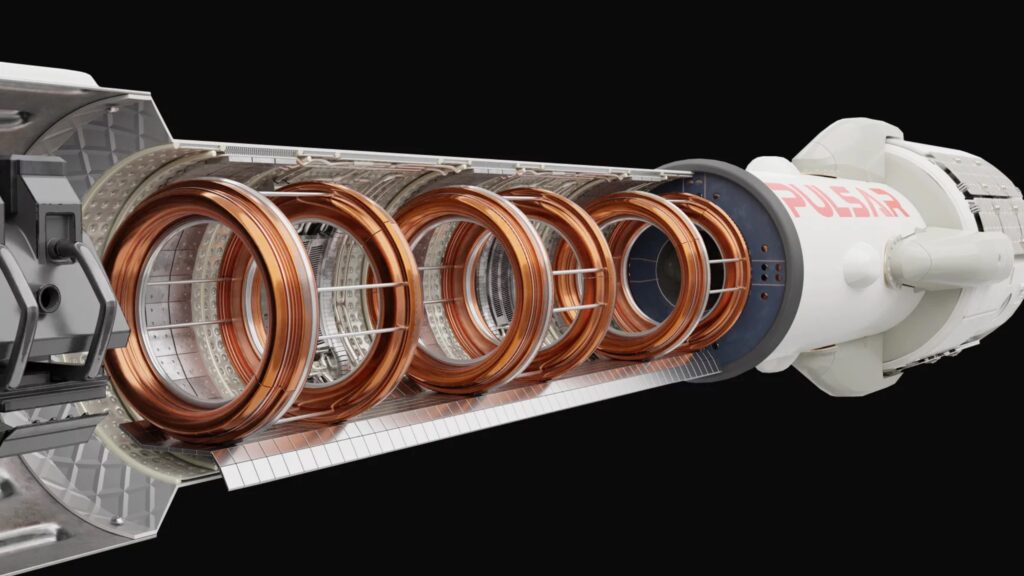
When companies like Pulsar Fusion reach the commercial stage and can provide fusion propulsion in space, the next space race will take off. The question is: who will be able to provide the cheapest human orbital launch option? The type of fusion propulsion that Pulsar Fusion is developing is not going to work down on Earth’s surface or in the atmosphere, only in space. So, there will still be a need for orbital launch providers for a long time to come (unless Disclosure changes everything).
As yet, there are no credible technologies being developed for launching off the surface.
Chemical rockets are still the only way humans can leave Earth. Other technologies like ion engines, fusion or thermal-nuclear propulsion, or laser-based propulsion are only effective in the vacuum of space and/or in micro/zero gravity.
More launchers are coming
There are, however, several ongoing developments from new contenders attempting to reach orbit with reusable rockets, and new spaceplanes. US-based Firefly is one, Radian Aerospace another. SpaceX is, of course, also a contender if it can get the giant upper stage that is the Starship to take off and land safely. Its Dragon capsule is only somewhat reusable.
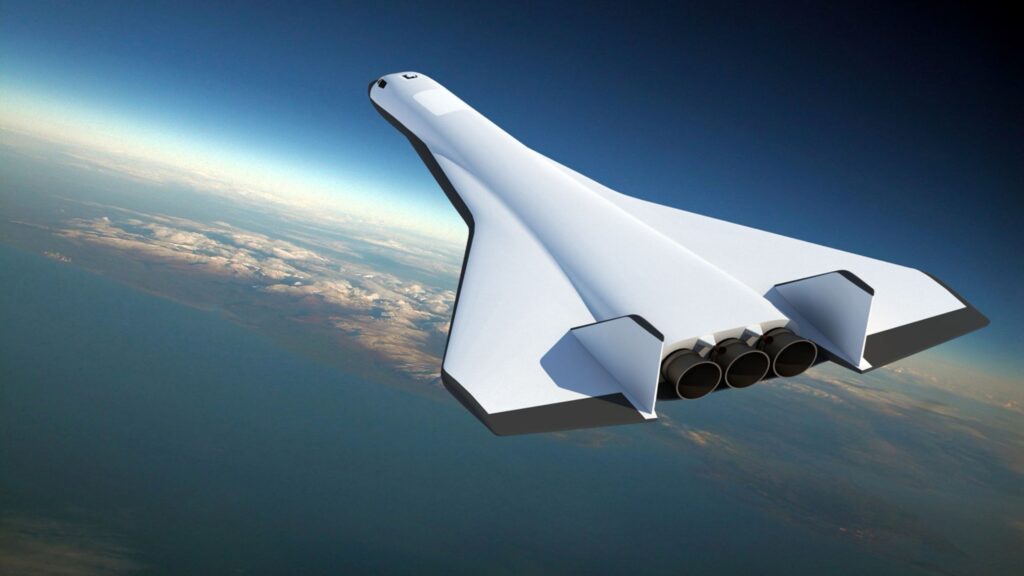 Rendering of the Radian spaceplane
But wait, there’s more… there are companies in Germany, China, India, Pakistan, Norway, and the UK, to name a few, that are all trying to achieve reusable spaceflight. These providers all have timelines with test launches planned in 2026 and 2027, so stay tuned to this space.
The Orion spacecraft weighs around 30 tonnes, and as such could be lifted to lunar injection orbit not only on the SLS but also possibly with Blue Origin’s or SpaceX’s systems in development (New Glenn and Starship).
But as of now, SpaceX remains the only private option for going to orbit.
We’ll update this space on all human-rated orbital launch options as they become available, keeping you, the advanced future digital nomad, informed on all options of travel.
Orion Spacecraft with European Service Module (ESM) Factsheet
- Purpose: The Orion Multi-Purpose Crew Vehicle (MPCV) is designed for deep space missions, carrying up to four astronauts beyond low Earth orbit to the Moon, asteroids, and potentially Mars.
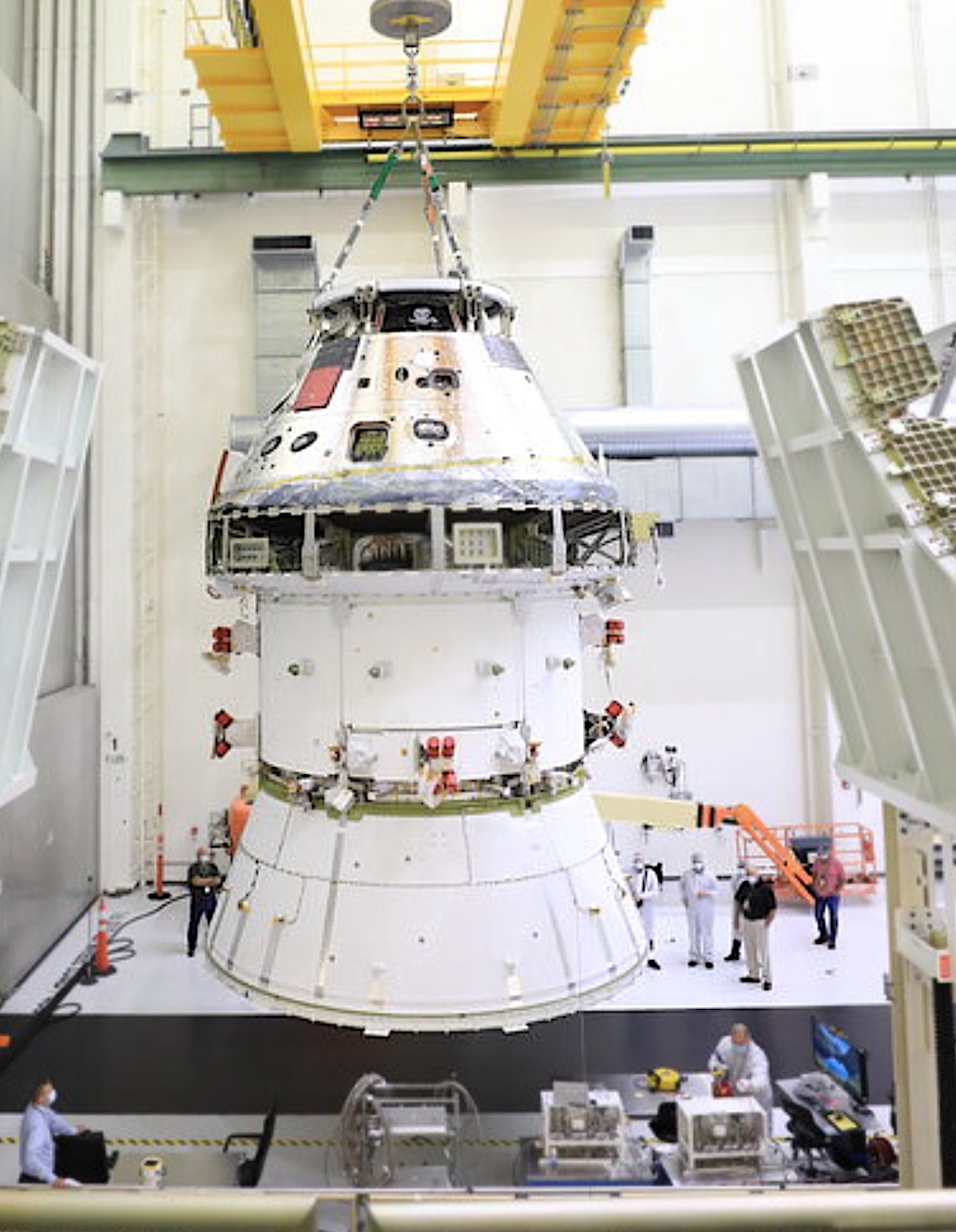
- Components: Comprises a Crew Module (CM) by Lockheed Martin and a European Service Module (ESM) by Airbus Defence and Space, connected via a Crew Module Adapter.
- ESM Role: Provides propulsion, electrical power, thermal control, water, oxygen, and nitrogen for crew life support.
- Design: ESM is cylindrical, 4m in diameter and height, weighing over 13 tons at launch, with 20,000+ components and 12km of cables.
- Propulsion: Features a main Orbital Maneuvering System Engine, eight auxiliary thrusters, and 24 attitude control engines, powered by 8.6 tons of propellant.
- Power: Four solar array wings with 15,000 cells generate 11.2 kW, sufficient for two households, supporting longer missions without fuel cells.
- Artemis Program: ESMs power Artemis I (uncrewed, 2022 success), Artemis II (crewed, 2025), and Artemis III (lunar landing, 2026).
- International Collaboration: ESA and Airbus build ESMs in Bremen, Germany, with components from 10 European countries and the U.S.
- Durability: Supports 21 days undocked, six months docked, with thermal systems for extreme space conditions.
This post is an example of how a news post in a new space-related news outlet could look. Courtesy of Webonanza.com, where we develop editorial content.